
Berberine supplement: what to know before you take it
By Plum Supplements · 8 min read
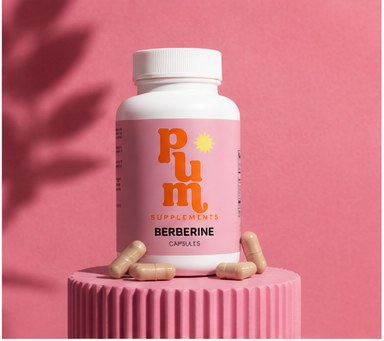
Berberine is a yellow plant compound found in shrubs such as barberry, goldenseal, and Oregon grape. It has a long history in traditional Chinese and Ayurvedic practice and is now taken as a dietary supplement to support healthy blood sugar levels already within the normal range and metabolic health. It is not a medication.
Talk to your physician before use, especially if you take prescription medication.
What is berberine?
Berberine is an alkaloid, a naturally occurring plant compound, that gives the roots and bark of several shrubs their bright yellow color. Common sources include barberry (Berberis vulgaris), goldenseal (Hydrastis canadensis), Oregon grape, and Coptis chinensis, sometimes called Chinese goldthread. In supplements, it usually appears as Berberine HCl, a stable salt form that makes the compound easier to measure and encapsulate.
How has berberine been used traditionally?
Plants containing berberine have been part of traditional Chinese and Ayurvedic practice for a very long time, most often prepared as teas or tinctures for digestive comfort. Its intense yellow color also made it useful as a natural dye. The modern interest in berberine as a daily supplement is more recent and comes from laboratory and human research into how the compound interacts with metabolism.
What does berberine support?
Berberine has been studied for its role in glucose and lipid metabolism, including how the body manages energy at the cellular level. As a dietary supplement, it is taken to support healthy blood sugar levels already within the normal range and overall metabolic health, as part of a balanced diet and active lifestyle.
It is important to be clear about what that means. Berberine is not a treatment for any disease, it is not a replacement for prescribed medication, and it should never be used to manage a medical condition without your physician's involvement.
How do people typically take berberine?
Studies on berberine have commonly used 900 to 1,500 mg per day, often divided into two or three doses taken with meals. Splitting the amount is common because berberine is relatively short-lived in the body, and because taking it with food can be gentler on digestion.
| Approach | How it works | Why people choose it |
|---|---|---|
| Full serving with one meal | Take the full labeled serving with your largest meal | Simplest to remember |
| Split across two meals | One capsule with lunch, one with dinner | Spreads intake through the day; may be gentler |
| With food, always | Avoid taking it on an empty stomach | Reduces chance of stomach upset |
Whatever approach you use, follow your product label or your physician's direction, and do not exceed the labeled serving.
Who should talk to a physician before taking berberine?
Talk to your physician before use, especially if you take prescription medication. Berberine can affect how the body processes some medications, and it may add to the effects of medications used for blood sugar or blood pressure. Do not use berberine if you are pregnant or nursing, and do not give it to children.
In particular, check with your physician or pharmacist first if you:
- Take any prescription medication, including medication for blood sugar, blood pressure, or cholesterol.
- Take blood thinners, immunosuppressants, or medications metabolized by the liver.
- Are pregnant, planning a pregnancy, or nursing.
- Have a liver or kidney condition, or any known medical condition.
- Have surgery planned.
Are there side effects?
The most commonly reported side effects in studies are digestive: stomach upset, cramping, constipation, or loose stools. Taking berberine with meals and splitting the serving can help. If you notice anything unusual, stop use and contact your healthcare professional.
What to look for on a berberine label
- The form, usually Berberine HCl, and the amount per serving.
- How many capsules make up a serving.
- A clear warning section that mentions medications and pregnancy.
- A short other ingredients list.
- Third-party testing you can actually view.
How Plum Berberine is labeled
Our Berberine provides 1,200 mg of Berberine HCl extract per two capsule serving, with vegetable cellulose capsule, rice flour, and magnesium stearate as the other ingredients. The suggested use is 2 capsules daily with a meal, or as directed by your healthcare professional. It is third-party tested and made in GMP-certified facilities.
Key takeaways
- Berberine is a plant compound from shrubs like barberry and goldenseal.
- It supports healthy blood sugar levels already within the normal range and metabolic health.
- It is a dietary supplement, not a medication or treatment.
- Take it with meals; many people split the serving.
- Talk to your physician before use, especially if you take prescription medication.
Frequently asked questions
What is a berberine supplement?
A berberine supplement provides berberine, a yellow plant compound from shrubs like barberry and goldenseal, usually as Berberine HCl. It is taken to support healthy blood sugar levels already within the normal range and metabolic health. It is a dietary supplement, not a medication, and not a treatment for any condition.
How much berberine should I take?
Follow your label or physician. Studies have commonly used 900 to 1,500 mg per day, often split with meals. Plum Berberine provides 1,200 mg per two capsule serving, taken daily with a meal. Talk to your physician before use, especially if you take prescription medication.
Can I take berberine with my medication?
Talk to your physician before use, especially if you take prescription medication. Berberine can affect how the body processes certain medications and may add to the effects of blood sugar or blood pressure medication. Your physician or pharmacist can tell you whether it is appropriate for you.
Should berberine be taken with food?
Yes. Taking berberine with a meal is the most common approach and can be gentler on digestion. Many people split their serving between two meals. The most reported side effects are digestive, so pairing it with food is a sensible default.
Who should not take berberine?
Do not use berberine if you are pregnant or nursing, and do not give it to children. People taking prescription medication, or with liver, kidney, or other medical conditions, should talk to a physician first. Stop use and contact a professional if you notice unusual symptoms.
These statements have not been evaluated by the Food and Drug Administration. This product is not intended to diagnose, treat, cure, or prevent any disease.